
If you’re planning your trip and wondering how to have internet in Vietnam from the moment you land, in 2026 there are plenty of options — from modern eSIMs to old-school physical SIM cards. Today we break them all down for you.
We won’t lie to you: we’re actually fans of using trips to disconnect, and we mostly rely on the WiFi at hotels, cafés and restaurants. It lets us live in the moment, and in our experience it’s the best way to balance your digital wellbeing while traveling.
In this article we’ll tell you everything you need to know about eSIMs and physical SIM cards in Vietnam: how they differ, which companies to choose from, their pros, their cons… and, most importantly, which one suits you best depending on the kind of traveler you are.
Stick around, because we’re about to save you time, money… and the odd headache!
In this post
Comparison table of the best eSIMs for Vietnam
Here’s a summary of all the options in table form, with prices standardized for a sample 15-day trip through Vietnam, so you can see the differences between them clearly for yourself.
Pick your Vietnam eSIM in 30 seconds 📶
(reference prices for a 15-day trip)
- HOLAFLY 👉 If you want unlimited data, check this Vietnam eSIM. Coverage on Vinaphone, Mobifone and Viettel, with 24/7 support.
- SAILY 👉 If you’re after a tight budget, check this 20 GB eSIM. Competitive plans you can tailor to your data needs.
- AIRALO 👉 Great value for money with this Vietnam eSIM. Supports top-ups and solid coverage on Viettel.
- NOMAD 👉 Ideal for longer trips with this long-duration eSIM. Plans up to 45 days.
- MAYA MOBILE 👉 A good pick if you’re visiting several countries with this regional eSIM. Use your data in Vietnam or across several Asian countries.
- BYTESIM 👉 Worth a look if you want a local number with this eSIM with daily data. Offers incoming calls and per-day plans.
Our pick of the best eSIMs for Vietnam
- Holafly is the most beginner-friendly option: unlimited data, coverage on the main networks (Viettel, Vinaphone and Mobifone) and, above all, responsive 24/7 support for anything unexpected.
- ByteSIM takes the trophy for data and price: with 3 GB per day (≈45 GB in total) for US$31.90, you can forget about top-up scares.
The best ways to get internet in Vietnam
Here are the main options you can use as a traveler to stay connected throughout your trip to Vietnam.
eSIM for Vietnam
If having mobile data the moment you land matters to you — without hunting for a shop or dealing with paperwork — the most practical option is an eSIM. This virtual card gets you online from the second you step off the plane, with no physical SIM required, and you can buy it online before you travel.
- Use: Mobile data only — as a rule, calls aren’t included.
- Pros: Perfect for having internet pre-activated before you arrive.
- Cons: Pricier than a regular SIM. Some phones can be glitchy when activating them, depending on your device.
Physical SIM card for Vietnam:
This is the classic card you insert into your phone. You buy it at the airport or at phone shops around the country. You’ll need to remove your usual carrier’s SIM and insert the local one — unless your phone takes two SIMs.
- Use: Various plans, both data-only and data plus calls.
- Pros: Works in any phone. You get a local number with calls included. Cheap, and purchased directly from the local carrier.
- Cons: You can only get it after you arrive.
What is an eSIM?
An eSIM is simply a fully virtual, digital SIM card that requires no physical SIM to work. It activates like an app on your phone, usually via a QR code.
With an eSIM you carry pre-activated data on your phone, so the moment you land in Vietnam you can simply start using it and get online just as you would back home.
Almost every eSIM provider has an app and a range of data packages that vary in price depending on the duration and the country or region you choose.
If you’re visiting more than one country, these providers usually offer very attractive regional plans that keep you connected across several countries with a single eSIM.
How does an eSIM work?
Using an eSIM is extremely simple:
- Buy a Vietnam eSIM on the website of any provider that offers them.
- You’ll receive an email with a link to the app or the activation QR code.
- Install the app from your chosen eSIM provider.
- Activate the data package you purchased.
- Once you land in Vietnam, your eSIM data is ready to use.
One thing worth knowing about these cards: ideally, install and activate them before leaving your home country, while you still have internet access to set everything up — that way it’s already working when you arrive.
Benefits of using an eSIM on your trip through Vietnam
- Saves time and paperwork.
- You bring it installed from home, so you have data the moment you land.
- Fully virtual — no physical SIM card needed.
- You can buy and activate multiple data packages for different countries — so besides Vietnam, you can set up separate plans for Cambodia, Thailand, Laos or wherever else your trip takes you.
The not-so-great side of eSIMs in Vietnam
- The price tends to be somewhat higher than a local SIM.
- You don’t get a local number, so no calls or SMS. If you only need data, that’s fine — but if you need to call local numbers, you usually won’t be able to.
Not every phone on the market today is eSIM-compatible, so it’s best to check your device’s compatibility before buying.
Which is the best eSIM for Vietnam? The main options
Here’s a rundown of the main eSIM providers for your trip through Vietnam.
Holafly eSIM: unlimited data and solid coverage for your trip
Over our trips around the country we’ve put several of these eSIMs to the test, and so far our favorite is the Holafly eSIM, both for price and ease of use.
The main advantages we’ve found in this eSIM for a trip through Vietnam:
- You can customize the number of days and enjoy unlimited data for the whole period — ideal if you’re a heavy internet user while traveling.
- They have agreements with Vinaphone, Mobifone and Viettel, the country’s three main carriers, guaranteeing good coverage wherever you are.
- If you change your mind or your trip falls through, they refund what you paid (as long as you haven’t activated the card).
Holafly’s main drawback is that it doesn’t offer capped plans for those who use data only occasionally.
That makes the price somewhat higher than other providers, since every plan includes unlimited data — which can be overkill if you don’t use much internet while traveling.
As a reader of the blog, here’s a 5% discount on their prices, which you’ll find through this link.
| Duration | Data | Price |
| 7 days | Unlimited | ~US$26 |
| 15 days | Unlimited | ~US$51 |
| 30 days | Unlimited | ~US$75 |
Saily eSIM: customizable and affordable
Another eSIM we’ve tested and that has also worked well for us is Saily. What we like most is that you choose how much data you need — so if you’re a light user, you end up paying less. Ideal for those who only want to be connected just enough.
The catch is that you can’t pick the exact number of days. You have to fit into the preset packages, which isn’t always practical.
Pros of the Saily eSIM
- Very competitive prices: Plans start at US$8 for 3 GB over 30 days.
- Plans customizable by data: You pick how many GB you need, so you don’t overpay if you only use WhatsApp and maps.
- Ideal for light data users: Perfect for those who just browse, use social media or basic apps.
Cons of the Saily eSIM
- You can’t choose the exact duration: You’re limited to predefined plans (7 or 30 days, for example).
- No unlimited data: If you run short, you’ll need to top up or buy another package.
- No local number or calls: Mobile data only.
Here’s a small discount as well in case it fits your plans.
| Duration | Data | Price |
| 7 days | 1 GB | US$7.99 |
| 30 days | 3 GB | US$8.99 |
| 30 days | 5 GB | US$11.99 |
| 30 days | 10 GB | US$19.99 |
| 30 days | 20 GB | US$30.99 |
Airalo eSIM: for those who need little data
Another major eSIM provider is Airalo. With growing demand and coverage in nearly 200 countries, Airalo offers Vietnam plans that, in our opinion, are ideal for occasional data users who don’t need to be online all the time.
If your trip is short but you need more gigabytes, you’ll have to go for one of the monthly plans, which are the only ones with larger data allowances. The good news is that, even on a 30-day plan, their prices remain very reasonable — it may well work out cheaper than other providers.
Here’s a small discount too.
Pros of Airalo
- Good price per GB: Their plans are among the cheapest on the market — ideal for tight budgets.
- Flexible plans: You can choose between several data amounts.
- Top-ups supported: You can extend your plan without switching eSIMs or reinstalling anything.
- Coverage: Runs on reliable local networks like Viettel, guaranteeing a good signal almost everywhere in the country.
Cons of Airalo
- The data allowance on the short-trip options is minimal, so they only work for very occasional use.
- No unlimited data: All their plans are capped, however generous.
- Data only: No local number or calls included.
- May need a little manual setup: Some phones don’t detect the APN automatically (though it’s easy to configure).
| Duration | Data | Price |
| 7 days | 1 GB | US$4.50 |
| 15 days | 2 GB | US$7 |
| 30 days | 3 GB | US$9.50 |
| 30 days | 5 GB | US$13 |
| 30 days | 10 GB | US$21 |
| 30 days | 20 GB | US$32 |
Nomad eSIM: cheap and simple
If you’re after a cheap eSIM that simply gets the job done, the Nomad eSIM for Vietnam is probably your best bet.
With very low prices and an easy-to-use app, Nomad positions itself as the low-cost alternative closest to what physical SIM cards offer. That said, keep in mind it doesn’t include a local number for calls, so it may not be the best option if you need to be reachable by phone locally.
| Duration | Data | Price |
| 7 days | 1 GB | US$6 |
| 30 days | 3 GB | US$10 |
| 30 days | 5 GB | US$13 |
| 30 days | 10 GB | US$19 |
| 30 days | 15 GB | US$20 |
| 45 days | 20 GB | US$30 |
Pros of Nomad
- Low prices
- Coverage on Mobifone and Vietnamobile.
- Simple app
- Plans of up to 45 days for longer trips
Cons of Nomad
- Few options for short trips with small data amounts.
- Not compatible with the Viettel and Vinaphone networks
Maya Mobile eSIM: ideal for multi-country trips
What we like most about the Maya eSIM is its focus on regional plans, ideal for those traveling through several countries.
For example, if you’re heading to Vietnam, you can get an eSIM with unlimited data just for this country — or go for the Asia eSIM, which for a very similar price lets you connect in up to 12 countries without switching cards or buying an extra one.
While almost every provider offers this kind of regional plan, we think Maya has made these services its specialty, so it’s probably the best option if you’re planning to visit more than one country in Southeast Asia.
Pros of the Maya Mobile eSIM
- Regional plans: Choose between Vietnam-only plans or all-Asia plans (up to 12 countries) without switching cards if you’re visiting more destinations.
- Good coverage: Runs on reliable local networks like Viettel, one of the country’s best.
- Flexible plans: You can choose between different durations.
- Top-ups supported: If you run out of data, you can extend your plan without reinstalling another eSIM.
Cons of the Maya Mobile eSIM
- Their unlimited data: Unlike Holafly, their unlimited-data plans are more expensive.
- No local number included: No local calls — data only.
Here’s a comparison table of their rates:
| Duration | Data | Price |
| 7 days | 3 GB | ~US$9 |
| 10 days | 5 GB | ~US$14 |
| 15 days | 10 GB | ~US$19 |
| 30 days | 20 GB | ~US$34 |
| 30 days (Asia) | 20 GB | ~US$40 |
| 30 days (Asia) | Unlimited | ~US$88 |
ByteSIM eSIM: with a local number option
After Holafly, another excellent eSIM option for traveling through Vietnam is ByteSIM. There’s a lot to like here, but two things stand out: you can choose between total-data or per-day plans (2 GB per day, for example), and it includes the option of a local number.
Another strength is that it offers coverage on all three of the country’s main carriers: Viettel, Vinaphone and Mobifone, guaranteeing a stable connection practically anywhere.
That local number is a rarity in the eSIM world, and it can come in especially handy if you need to receive calls — without depending on the internet or burning data on messaging apps.
Pros of ByteSIM
- Good prices
- Choose between per-day data plans or the classic total-data plans.
- Option of a local number for incoming calls, on top of data.
- Coverage on Viettel, Vinaphone and Mobifone
Cons of ByteSIM
- The local number option is limited to incoming calls — you can’t call out.
| Duration | Data | Price |
| 7 days | Unlimited | US$26.50 |
| 7 days | 3 GB/DAY | US$17.90 |
| 15 days | Unlimited | US$46.50 |
| 15 days | 3 GB/DAY | US$31.90 |
| 20 days | Unlimited | US$53.90 |
| 20 days | 3 GB/DAY | US$39.90 |
These are just some of the main eSIM providers available for a trip to Vietnam — the options keep multiplying these days, so if none of these convinces you, it’s worth a deeper search of your own.
Best local SIM cards you can buy in Vietnam
If you’d rather use a physical SIM card, several phone companies in Vietnam offer traveler-specific SIMs.
They all offer different packages: data-only, or data + calls. Depending on what you need (whether you just want WhatsApp, or you also plan to make local calls), pick whichever fits your trip best.
Here’s a rundown of what, in our experience, are the best SIM cards in Vietnam, based on the main mobile carriers you’ll find in the country.
Viettel tourist SIM
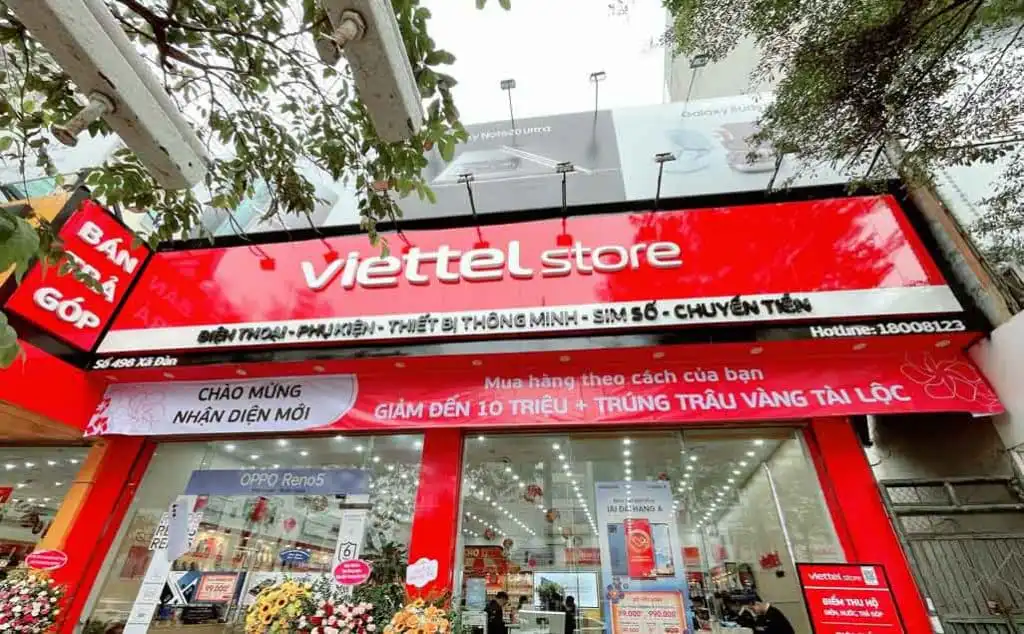
Viettel is probably the most widespread phone company in Vietnam, with countless shops and sales points across cities and towns. They generally have good coverage almost everywhere and fairly tight prices.
- Coverage: Generally very good across the whole country, rural areas included.
- Packages and rates: You can check Viettel’s tourist SIM packages and rates on the company’s website.
Vinaphone tourist SIM
VinaPhone is the country’s second-largest carrier and runs one of Vietnam’s biggest mobile networks, with good coverage in every city and the main tourist destinations.
- Coverage: Very good, in urban areas and the main tourist spots alike.
- Packages and rates: You can check Vinaphone’s tourist SIM rates and packages on the Vinaphone website.
Mobifone tourist SIM
Vietnam’s third-largest phone company. It offers affordable prices and mainly data packages; coverage can falter a little in more rural or remote areas, but it’s good overall.
- Coverage: Generally good, though it can dip slightly in some mountainous areas.
- Packages and rates: You can check Mobifone’s tourist SIM rates and packages on their website.
Vietnamobile tourist SIM
The last on our list and the country’s fourth carrier by users. Its coverage struggles quite a bit in parts of Ha Giang and the north, so we don’t recommend it if you’re heading to that area — elsewhere, generally no problem.
- Coverage: Weak in Ha Giang and the northern mountains. Fine in the rest of the country.
- Packages and rates: You can check Vietnamobile’s tourist SIM rates and packages here
Where to buy a SIM card for your trip through Vietnam
Now that you know the different types of SIM cards in Vietnam and the country’s carriers, here’s some good news: buying a SIM card in Vietnam is super easy.
These are the main ways to get one:
Buying a SIM card at the airport
If you don’t want to wait until you reach the city, buying a SIM card at the airport is the simplest, most practical option.
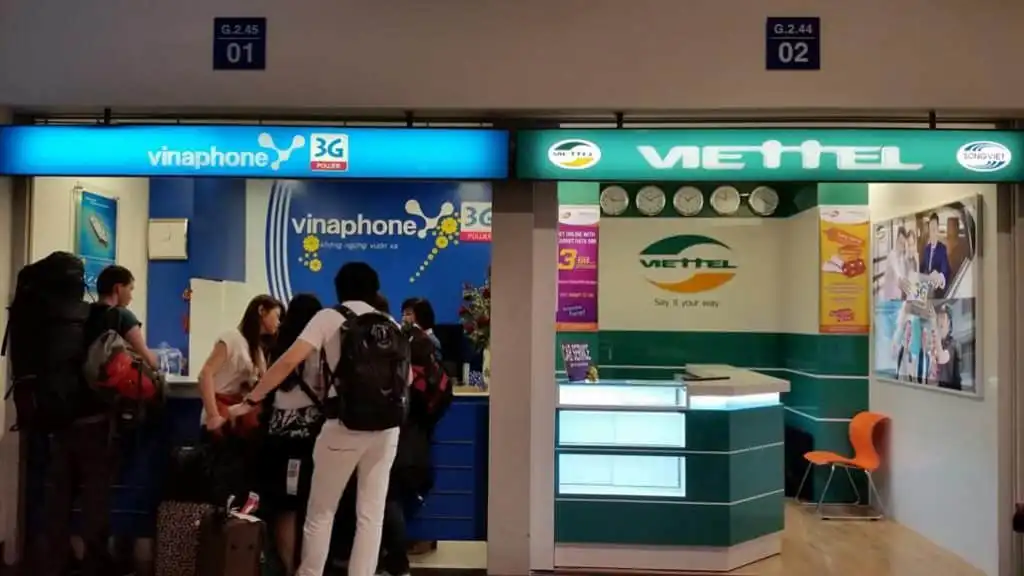
At both Noi Bai airport in Hanoi and Tan Son Nhat in Ho Chi Minh City you’ll find the different carriers’ booths in the arrivals area, next to the currency exchange offices.
Keep in mind, though, that buying a SIM card at the airport tends to be more expensive than in the city.
If you’re not in a rush to get online the moment you land, it pays to wait and buy it at a phone shop or kiosk in the city: you’ll save some money and, in many cases, have more plans to choose from.
Buying a local SIM card in the city
If you can wait until you reach the city, your best move is to go straight to one of the carriers’ official shops to buy and activate your SIM card. For our money, this is the smartest, cheapest option: better prices and usually a wider variety of plans than at the airport.
And if you happen to arrive on a Sunday or outside business hours, don’t worry. SIM cards are also sold at plenty of small shops, minimarkets and even travel agencies in the center of any Vietnamese city.
Tips to save mobile data on your trip through Vietnam
After several trips, this is what we’ve learned through trial and error about saving mobile data. These tricks let us travel 3 weeks across Vietnam spending less than US$11 on data each — apply them well and you won’t have to go begging for WiFi at every café.
- Turn on data saver mode in all your apps. Instagram, Maps, YouTube… they all have an option to consume less. Enable them. Our first time we did it too late and burned through a gig in the middle of Ninh Binh uploading a couple of reels.
- Download offline maps from Google Maps or Maps.me on your hotel WiFi before reaching each place. If you’ll be hopping between regions, download them over WiFi at your hostel.
- Avoid uploading photos and videos on the spot. Save them and upload at night over WiFi. Hostels in Vietnam have decent WiFi, even in rural areas.
- Turn off automatic updates over mobile data. One morning we woke up with no data left because the phone had decided to update every app over cellular. Lesson learned the hard way.
- Share data with others only when strictly necessary. If one of you has credit left and the other doesn’t, share a hotspot as a last resort. In Vietnam, data runs out faster than you’d think.
Internet in Vietnam: frequently asked questions
Here we answer the most common questions we get about staying connected during your trip through Vietnam, so you arrive prepared and surprise-free.
In our view, if we were taking a trip to Vietnam and wanted to buy an eSIM, we’d go with one of these two options:
1. Holafly: It has unlimited data as well as coverage on the country’s 3 main networks (Viettel, Vinaphone and Mobifone), plus 24/7 support for anything unexpected that comes up.
2. ByteSIM: Excellent data-to-price ratio. It offers 3 GB per day (≈45 GB in total for a 15-day trip) for around US$32.
If you go for a local SIM, the main companies to choose from in Vietnam are Viettel, Vinaphone and Mobifone, the country’s biggest carriers.
In general, Viettel and Vinaphone offer the best coverage, especially if you’re planning to visit rural or mountainous areas like Sapa or Ha Giang. Mobifone and Vietnamobile have good coverage in cities and tourist areas, but can struggle in more remote regions. That gap is gradually closing, though, as every carrier keeps improving its network.
No, don’t worry: your WhatsApp is tied to your phone, not to whichever SIM or eSIM you use.
That means that even if you swap the physical card or use a local eSIM in Vietnam, your WhatsApp account keeps working with your usual number and all your chats. No changes or extra setup needed.
Yes — as long as your phone is dual SIM, either because it holds two physical cards or because it supports a physical SIM + eSIM combo.
That way you can keep your home number active alongside the Vietnamese number, using both on the same phone. Very handy if you want to keep receiving messages or calls on your usual number while using local data and calls on the Vietnamese SIM.
✔️ Information reviewed and last updated on February 7, 2026