
Built in the 11th century in honor of Confucius, the Temple of Literature is an obligatory stop on your route through Hanoi that you shouldn’t miss. Within its walls, the empire’s scholars were educated — and though it initially admitted only the high-born, over time it opened up to students from different parts of the country.
In this post
The Temple of Literature, Vietnam’s first university
What was once Vietnam’s first university has seen students, scholars and emperors pass through its grounds — and today, crowds of visitors who come to contemplate the remains of what this place once was.
The harshness of its exams and the rigidity of its rules were famous throughout the country, and many failed to pass such demanding tests. Those who succeeded, however, earned the honor of having their names carved into the stone steles mounted on turtle heads, many of which are still preserved.
What to see at the Temple of Literature
A good part of the complex’s interior has been lost — it was originally considerably larger — but you can still walk through its main areas, some of them recently reconstructed.
The interior is laid out across five courtyards, entered through a series of gates. Inside, you’ll find statues of the figures who shaped its history, all loaded with symbolism. Here’s a summary of each courtyard.
The great gate
Opening the whole complex stands the great gate, an impressive doorway decorated with an inscription reading “Van Mieu Mon” (Gate of the Temple of Literature) in Chinese characters. This gate was rebuilt during the 20th century.
The first courtyard
Just past the entrance you’ll find the first courtyard, ringed by gardens where students would spend the little free time they had between books, strolling and unwinding among the trees.
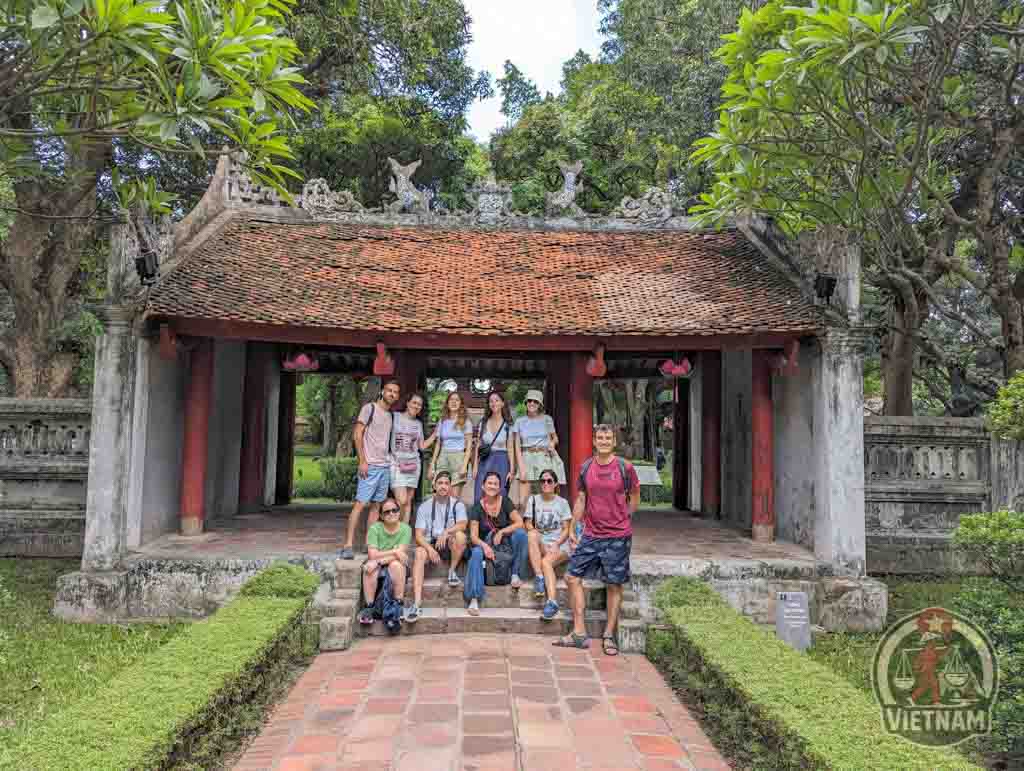
The highlight here is undoubtedly the great gate (Đại Trung Môn) leading to the next courtyard, crowned with koi carp — a deeply symbolic element of Chinese and Vietnamese culture, whose legend represents the sacrifice and perseverance needed to reach one’s goals; in this case, the students’ quest to become scholars and government officials.
The red-tiled roof rests on robust wooden pillars forming three separate doorways.
The second courtyard (Khuê Văn Các)
In the second courtyard stands the temple’s most iconic image, known as Khuê Văn Các in Vietnamese: a pavilion of splendid proportions surrounded by lovely gardens, built in the early 19th century and now one of the main symbols of the city of Hanoi.
The third courtyard (Thien Quang Well)
Right through the gate you’ll see a huge pond occupying most of the third courtyard, flanked by no fewer than 82 stone steles mounted on turtles, engraved with the names of 1,304 students who passed the exams.
Many of the turtles’ heads (the turtle symbolizes longevity and wisdom in Vietnamese culture) are smooth and shiny — stroking them, so the belief goes, brought students luck in passing their tests.
The fourth courtyard (Đại Thành Môn)
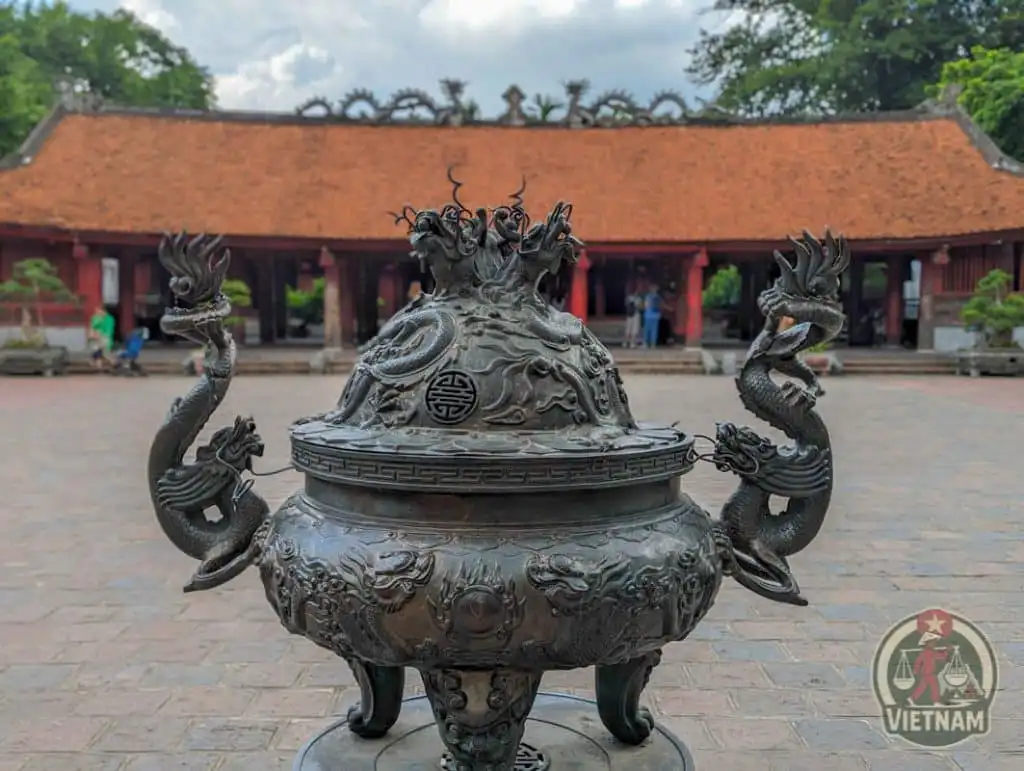
We arrive at one of the temple’s main sections. At the very center of this courtyard you’ll find an enormous bronze incense burner — and above all, the altar where Confucius is worshipped, alongside his four most outstanding disciples.
The fifth courtyard: the Imperial Academy
Finally we reach the last courtyard, spread over two floors. Upstairs are altars with the figures of three emperors who contributed enormously to the creation and development of the temple and the academy.
On the ground floor you’ll see an altar dedicated to Chu Van An, considered one of the finest and most respected teachers in all of Vietnam.
On either side of the courtyard sit two small pavilions housing a bell and a drum of grand proportions.
Temple of Literature: hours and prices
- Open daily from 8:00 am to 5:00 pm
- Entrance costs 70,000 VND (~US$2.70). Free for children under 15.
- If you want the full history of the place, you can rent one of the audio guides at the entrance for an extra 50,000 VND.
- Remember to dress appropriately.
How to get to the Temple of Literature
Its location makes it ideal to visit after the Ho Chi Minh Mausoleum, the One Pillar Pagoda or the Presidential Palace, all about 15 minutes away on foot.
Walking from the old quarter or Hoan Kiem lake takes no more than 30 minutes.
A curiosity about the Temple of Literature
Here’s a fun detail: if you’re in Vietnam and holding a 100,000 VND bill, take a good look — flip it over and you’ll find this beautiful place printed on one of its faces.
✔️ Information reviewed and last updated on January 7, 2026