
No trip to Vietnam is complete without a visit to Halong Bay, one of the country’s best-known places and one of its most recognizable images.
In this post we cover what to see in Halong Bay, how to visit the bay from Hanoi or Cat Ba island, the types of cruises and boat tours available and what to look for when choosing the one that fits you best. You’ll also find practical tips and useful information for planning your visit to this corner of Vietnam.
Pick your Halong Bay tour or cruise in 30 seconds ⛴️
- 1 DAY 👉 If you’re short on time, check this 1-day Halong Bay tour from Hanoi.
- 2 DAYS / 1 NIGHT 👉 The most balanced option is usually a Halong Bay cruise with a night on board from Hanoi.
- 3 DAYS 👉 Ideal if you want to combine a day in Ninh Binh with 2 nights in Halong Bay from Hanoi.
- FROM CAT BA ISLAND 👉 On a highly recommended 1-day tour .
- FROM CAT BA ISLAND 👉 On a 2-day cruise around Lan Ha Bay .
- BOOK YOUR TRANSFER TO CAT BA 👉 Here are the schedules and options. .
In this post
The best Halong Bay cruises: which one to choose
Choosing a Halong Bay cruise can turn into a genuine odyssey if you’re not sure how to go about it. To spare you that, we’ve put together what are, in our view, some of the best boat tours in Halong Bay.
Because picking the right one isn’t just a question of price: the duration, the route, the type of boat and the level of comfort all weigh heavily on the final experience you’ll have during your visit.
Here’s a comparison table with our selection of Halong Bay cruises.
| Tour type | Price | Book |
|---|---|---|
| 1-day tour (Standard) | 1,300,000 VND (~US$50) | Here |
| 1-day tour (Premium) | 2,000,000 VND (~US$77) | Here |
| 2D/1N cruise (Premium) | 4,500,000 VND (~US$173) | Here |
| 2D/1N cruise (Luxury) | 8,000,000 VND (~US$308) | Here |
| 3D/2N cruise (Premium) | 6,800,000 VND (~US$262) | Here |
Cruise categories
Something fundamental when booking a Halong Bay cruise is being clear about the boat’s category. Just like hotels, cruises are usually rated by stars (1 to 5), and that category tends to reflect the condition of the boat and the level of service on board.
Broadly, the formula is simple: more stars means a higher price, but also a better chance of a well-maintained boat, more comfortable cabins and a more professional operation.
Even if you’re on a tighter budget, we recommend avoiding cruises below 3 stars, especially if you’re spending the night on board.
Types of boats in Halong Bay
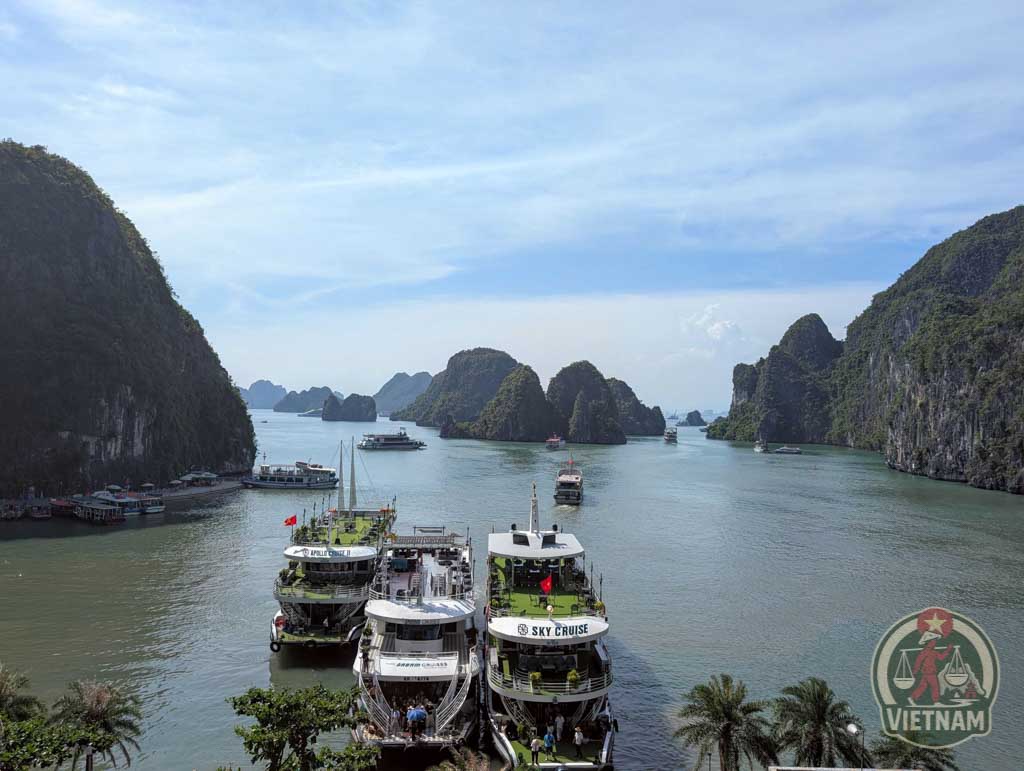
Junk boat (Vietnam’s traditional vessel)
The junk is a type of boat typical of Southeast Asia and one of the most recognizable thanks to its distinctive shape.
It’s a vessel traditionally used in times past for trade and transport, though today you can still sail on some that have been adapted for tourism, especially in the higher categories.
“Western-style” cruise ship (the classic one)
The kind that comes to mind when someone says “cruise”, though somewhat smaller in size to suit the area.
They tend to be modern, with a more “hotel-like” layout, although the experience depends more on the boat’s actual category (and its maintenance) than on the design.
Tips for choosing a Halong Bay boat tour
As in many crowded tourist destinations, Halong Bay has no shortage of travelers who’ve had bad experiences: scams, poor-quality services or promises that never materialize — turning what should be a once-in-a-lifetime experience into something far less pleasant.
A quick tip before you continue
Don’t gamble with your health in Vietnam
A medical surprise far from home gets expensive. We always travel insured with Heymondo: medical cover, 24/7 assistance and protection against setbacks like delays or lost luggage.
Get yours with a 5% discount → · applied automatically through this link
To help you avoid that, here are the key tips for choosing your Halong Bay cruise well and getting the most out of your visit.
1. Check how much time you’ll actually spend in the bay
This is key, above all on day trips. Often, a large share of the time goes to transfers from Hanoi rather than being on board or exploring the bay.
Before booking, look carefully at how much effective time you’ll spend sailing or doing activities in Halong Bay.
Avoid tours that promise a lot but barely let you enjoy the place.
2. Check carefully what the tour includes (and what it doesn’t)
Before booking, make sure you’re clear on what’s included in the cruise price and what isn’t. It’s easy to run into unexpected surcharges for activities, meals or services you assumed were covered.
Heads up: most tours don’t include drinks — not even water — and some activities like kayaking or cave visits may come at an extra cost.
If something doesn’t add up during the trip or isn’t as you expected:
- Stay calm and keep it civil — losing your temper won’t help your case.
- Try to communicate with the staff on board and resolve the problem on the spot.
- If it can’t be resolved, once your cruise ends, claim from the provider or agency for the included services you weren’t able to enjoy.
3. Be wary of bargains
An all-inclusive cruise for a ridiculous price? No thanks.
In Vietnam, as anywhere, cheap tends to come out expensive. And in Halong Bay this holds perfectly true: if someone offers you an “unmissable deal”, you’ll most likely end up either losing money or ruining your experience.
Tour prices are generally fair for what they offer. If you see something far below the usual range, there’s probably a catch: services that don’t exist, a boat in poor condition, or outright scams.
Our advice: don’t skimp on this part of the trip. Halong Bay is one of those places where it’s worth investing a little more. You’ll save elsewhere along the route — Vietnam is very affordable when it comes to transport, food and accommodation.
To give you an idea, these are the minimum reference prices:
- 1-day trip: From 1,200,000 VND (~US$46)
- 2-day, 1-night cruise: From 3,000,000 VND (~US$115)
4. Beware of booking at the Hai Phong port
Heading to the Hai Phong port on your own with the idea of booking a cruise right there might seem like a way to save money… but it doesn’t always end well.
Local rackets operate in this area, preying on travelers without a prior booking, and scams are frequent: from ghost tours to boats in dreadful condition or last-minute price changes.
Our advice: don’t improvise. Always book with a trusted agency or website, or one with clear reviews and ratings.
5. Theft
Although it’s far from common, there have occasionally been cases of theft during Halong Bay cruises. To avoid any upsets, the best approach is combining common sense with basic precautions:
- Don’t flaunt your valuables.
- Keep your money on you at all times — if you’re traveling with a lot of cash, consider buying a waterproof pouch beforehand so you can carry it with you at every moment.
6. Be patient with the crowds
Halong Bay is one of the most visited places in Vietnam — and in the entire world — so if you were hoping to sail the area alone, know that this almost certainly won’t be the case.
Rather, you’ll be sharing the boat and the sights with crowds of other tourists who, like you, have come from all over the world to see it. So be patient, be respectful, and try to enjoy the beauty of Halong Bay regardless of how many people are around you.
If you’re someone who’s easily bothered by mass tourism, we have to tell you: Halong Bay is not the place for you.

The 1-day Halong Bay tour: is it worth it?
The day trip is the fastest and simplest way to see Halong Bay, and the most common option for those traveling on limited time or who’d rather spend it getting to know other parts of the country.
These tours usually depart from Hanoi, where countless agencies and accommodations offer them, so they’re easy to book even at short notice.
As a general rule, they include pickup at your accommodation, the round-trip transfer to the port and a boat route through the bay lasting several hours.
Most trips also include lunch on board and some simple activity, such as kayaking or a short Vietnamese cooking class.
Typical itinerary of a 1-day Halong Bay cruise
Most day tours follow a fairly similar itinerary:
- Early departure from Hanoi and road transfer (about 2.5-3.5 hours) to the Halong port.
- Boarding and lunch on board, right as you start sailing through the bay.
Along the route, the norm is three stops:
- Ti Top Island – with a panoramic viewpoint and a small beach for a swim, weather permitting.
- Sung Sot Cave – the most famous cave in Halong Bay.
- Luon Cave – where you can paddle into the inner lagoon by kayak or rowboat.
Once the visits are done, the boat returns to port at sunset, and from there the transfer back to Hanoi begins, arriving after dark.
Pros of the 1-day Halong Bay tour
- It lets you see Halong Bay in very little time — ideal if you’re on a tight schedule or want to spend it on other parts of Vietnam.
- It’s usually the cheapest way to visit the bay.
- It includes transport to and from Hanoi, saving you headaches.
- It’s easy to book, even at very short notice.
Cons of the 1-day Halong Bay trip
- The actual sailing time in the bay is more limited than on 2-day tours.
- You visit the busiest areas, so crowds are common, especially in high season.
- You don’t get to enjoy the sunrise from the boat.
- The boat is smaller — so on one hand you’ll travel with fewer people, but the comforts are fewer too.
- The food tends to be on the poor side.
2D/1N cruise around Halong Bay
If you have a little more time or want the experience of sleeping aboard a Halong Bay cruise, these tours tend to be a very popular choice.
On two-day, one-night tours the route is usually very similar to the day trips, but with the activities spread across both days and including dinner and breakfast on board.
The main appeal of visiting Halong Bay on a two-day tour is the chance to watch the sunrise from the boat — something you can’t do on a single-day trip. Weather permitting, of course.
Advantages of the 2D/1N Halong Bay cruise
- If the weather cooperates, you can watch the sunrise over the bay — so don’t be lazy, set that alarm (remember the sun rises around 5:30 am in Vietnam).
- Some 2D/1N tours cover both Halong Bay and Lan Ha Bay, so you can visit the two of them.
- The boat is bigger and more comfortable than on the day tours.
Disadvantages of the 2D/1N Halong Bay cruise
- The price is considerably higher than the 1-day tour.
- It takes at least two days of your trip, which means taking them away from other places on your Vietnam travel itinerary.
- On many of them, the itinerary is very similar to the 1-day cruise.
- The best-rated tours sell out fast — cabins are limited, so if you don’t book ahead it’s easy to find them full.

3-day Halong Bay tour
If you’re thinking of visiting Halong Bay on a tour of more than two days, the most important thing is being clear on which areas are covered and which activities are included, since the options can vary quite a bit depending on the itinerary and the boat you choose.
On three-day tours it’s common to see both Halong Bay and Lan Ha Bay.
If you’d rather not spend all three days on board, there are very interesting options combining two days of sailing with one day in Ninh Binh — a common alternative among the tours in our selection of best cruises, and a great fit if you’re short on time to visit both places.
All of this also translates into a higher price — keep that in mind.

What to see in Halong Bay: the main points of interest
Halong Bay is essentially a vast seascape scattered with islets, which you sail among while stopping off to see some of its unmissable places.
Planning a visit to Halong Bay can get a bit confusing, but if you’d rather keep it simple, the most common way to visit is on a day trip from Hanoi or sleeping aboard a multi-day cruise.
Here’s what is without doubt our favorite two-day cruise, though there are others with strong reviews such as this 2-day option.
There are several areas and bays you can visit during your stay, among them:
- Halong Bay: The original, and the first to develop tourism. It’s the best known — and at times somewhat saturated — but packed with interesting places.
- Bai Tu Long Bay: Northeast of Halong Bay and known as “the dragon’s children”, it offers quieter cruises and plenty of caves and fishing villages.
- Lan Ha Bay: South of Halong Bay, it shares the same limestone-karst geography, but it’s somewhat less known and less visited — which makes it more peaceful.
- Cat Ba island: The largest island in the region, famous for its national park and adventure activities like hiking and cycling, and a great base for excursions around the different bays.
If you’ve already made up your mind to visit Halong Bay, here’s a rundown of the main points of interest that make up the bay, all of which you can see on your cruise or day trip around the area.

Sung Sot Cave
Located on Bon Hon island, this is one of the most spectacular caves you can visit in Halong Bay.
Its enormous interior is packed with stalactites, stalagmites and other spectacular formations. It’s included in practically every tour of the bay.

Cua Van floating village
Of all the floating fishing villages found around Halong Bay, Cua Van is one of the largest and most visited of them all.
Set against a backdrop full of romance, it’s without doubt a great place to learn about the culture and way of life of these families.

Luon Cave
Very close to Sung Sot cave lies Luon Cave, a maze of passages between islands that’s normally explored on a kayak excursion.
If you don’t feel comfortable paddling, many companies offer the option of touring the area in a traditional bamboo boat, no rowing required.

Titop Island
Commonly nicknamed the cemetery island, as the story goes that the sailors of a French ship wrecked in the area were buried here. Today it’s one of the many islands you can visit in Halong Bay.
This small islet is one of the main stops en route, where you can enjoy the beach or climb its nearly 500 steps to take in the views from the very top.

Dragon Eye Island
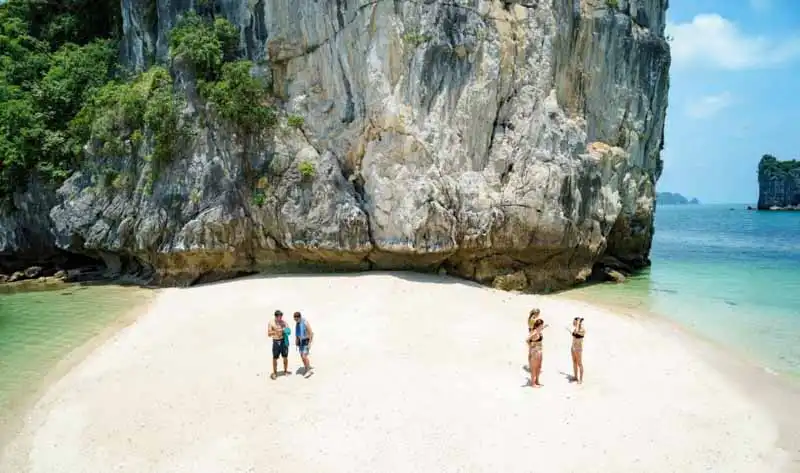
Sitting on the border between Halong Bay and Lan Ha Bay, this spectacular island offers white-sand beaches to enjoy.
But its main attraction is a small, circular lake in the middle of the island, whose breathtaking views will leave you amazed.
Lan Ha Bay, the beautiful alternative to Halong Bay
Located southeast of Halong, Lan Ha Bay stretches alongside the famous bay and shares an almost identical landscape, with karst formations and a well-preserved natural environment.
The big difference between the two is Lan Ha Bay’s smaller flow of visitors, which makes it a calmer, less crowded option for exploring the area.
Lan Ha Bay counts more than 400 islets, so it works perfectly both as an alternative to Halong Bay and for combining the two in a single trip, especially if you set out from Cat Ba island.

Monkey Island
One of the best-known places in Lan Ha Bay is Monkey Island. Fairly large in size, the island sits barely 1 km from Cat Ba island, and you can reach it from there via the Beo pier.
This mountainous island is ringed by beaches and known in the local language as Cat Dua, after the many pineapple plants that grow naturally here — though it’s been popularized as Monkey Island thanks to the monkeys thriving in its habitat.

Ba Ham lake
Formed by three small connected lakes and reachable by kayak or bamboo boat through a tunnel under the rock, Ba Ham lake is one of the most surprising places to visit in Lan Ha Bay.
Once inside you’ll find yourself surrounded by vertical walls nearly 30 m high, hung with stalactites, and an opening through which the light pours in — making this one of the most beautiful and captivating landscapes you can visit.
Ba Trai Dao
It’s actually 3 small islets that make up this spot, visited mainly for its views. Legend has it that a fairy from heaven fell in love with a fisherman and decided to steal three peaches for him. When the King of Heaven found out, he flew into a rage and turned them to stone — forming the 3 small islets you can see today.
Cat Ba island, the perfect base for exploring Halong Bay
Cat Ba is the main island of the archipelago and is well worth a visit in its own right.
It has enough attractions to fill several days, and many travelers choose it as a base for exploring the nearby bays, such as Lan Ha or Halong.
If you’re traveling with time to spare and prefer a slower pace, getting to Cat Ba and spending 2 or 3 days here, combining island outings with a cruise around the bay, is one of the best ways to discover this area.
One of its advantages is that cruises tend to be slightly cheaper departing from Cat Ba. However, getting here takes more logistics and time, so if you’re tight on days it may not be the most practical option.
You can book your tour departing from Cat Ba or check our complete article on Cat Ba to plan your visit better.
How to get to Cat Ba island from Hanoi
You can reach Cat Ba island by bus from Hanoi or other cities offering combined tickets for the transfer, which include the ride to the port, the ferry ticket and the bus on Cat Ba to whichever part of the island your accommodation is in.
You can check bus schedules from Hanoi to Cat Ba island at this link.
Bai Tu Long Bay, Halong Bay’s lesser-known extension
Bai Tu Long Bay stretches northeast of Halong Bay as a prolongation of it. In this area you can enjoy the sights in far greater peace, since the number of tourists visiting is much lower than in other parts.

Thay Cave
Known for the unique shapes of its stalactites, Thay Cave is one of the many caves scattered across the area. It reaches depths of up to 150 m, which makes exploring it an interesting experience if you’re touring Bai Tu Long Bay.

Vung Vieng Fishing Village
In the very heart of this bay, surrounded by breathtaking karst pinnacles, you’ll find this little-visited floating fishing village, reachable only by boat.
This special place gets fewer visitors than other floating villages in the area, and it’s a great spot to discover the singular life on the water of the roughly 50 families who call the village home.
Ban Chan Beach
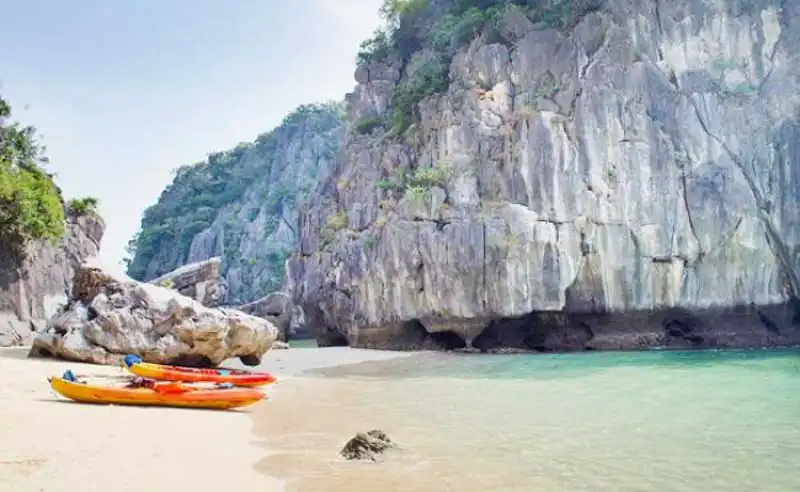
Without doubt one of the best beaches in the area — and probably among the best you’ll find in Vietnam. Emerald-green waters and white sand lend the landscape a magical touch and make this beach well worth adding to your visit, above all for the far smaller number of tourists you’ll encounter.

Thien Canh Son Cave
Located on Cong Do island — to reach it you’ll have to climb 100 steep steps along a trail, but the effort is rewarded by the multitude of stalactites you’ll find hanging from its walls.
What to do in Halong Bay: the top activities
1. Explore by kayak
If there’s one star activity in Halong Bay, it’s kayaking.
Almost all cruises offer it, since it’s the only way to access certain caves and inner lagoons such as Luon Cave, where the boats can’t enter.
Can’t kayak, or would rather not? No problem: on many tours you can opt for a guided rowboat instead — ideal if you prefer something more relaxed or you’re traveling with children.

2. Go trekking
Beyond the cruises, there are also a few chances to stretch your legs.
From the short but steep climb to the Ti Top Island viewpoint to the hiking trails through Cat Ba National Park, you’ll have several opportunities to explore the area’s corners on foot.
3. Cycle around Cat Ba
Hopping on a bicycle to explore Cat Ba island is one of the best ways to see many of its attractions, riding deep along its trails and reaching the different places waiting for you across the length and breadth of the island.
You can do it on your own or book one of the many guided tours available, which will lead you through the different areas.
We cover it in detail in this other article.
4. Unwind in the boat’s spa
Relaxing in the boat’s open-air jacuzzi while sailing through the stunning scenery of Halong Bay is without doubt a luxury increasingly within reach of all kinds of travelers — many cruises, especially the 2-day ones, now include this service as part of your trip around the bay.
5. Sleep on a (nearly) deserted island
With the sheer number of islands scattered across the area, it isn’t hard to find an agency offering the chance to spend the night on one of them.
It’s mainly the multi-day cruises that offer island overnights — a good option to keep in mind if you’re not a big fan of ship cabins, or simply prefer a night right on the beach.
6. Throw yourself a party
Many cruises organize parties on board after dark, designed for socializing, having a few drinks and meeting other travelers in a more laid-back atmosphere.
That said, drinks aren’t usually included in the tour, and prices on board can be quite steep compared with the rest of Vietnam. Keep that in mind if your budget is tight.
7. Learn Vietnamese cooking
If you book a multi-day Halong Bay cruise, it would be unusual for it not to include a Vietnamese cooking class.
It’s certainly a good way to get acquainted with the country’s gastronomy and to practice your skills in the exquisite way Vietnam cooks.
8. Watch the sunrise and sunset, a must in the bay
If you take a day trip, you’ll watch the sunset from the boat on the way back to port — and that alone is worth it.
If instead you choose a two-day tour and spend the night on board, you’ll also get the chance to see the sunrise… as long as you get up early. Bear in mind that sunrise in Vietnam falls between 5:00 and 6:00 am, depending on the time of year.

Halong Bay: history and legend of one of the 7 natural wonders of the world
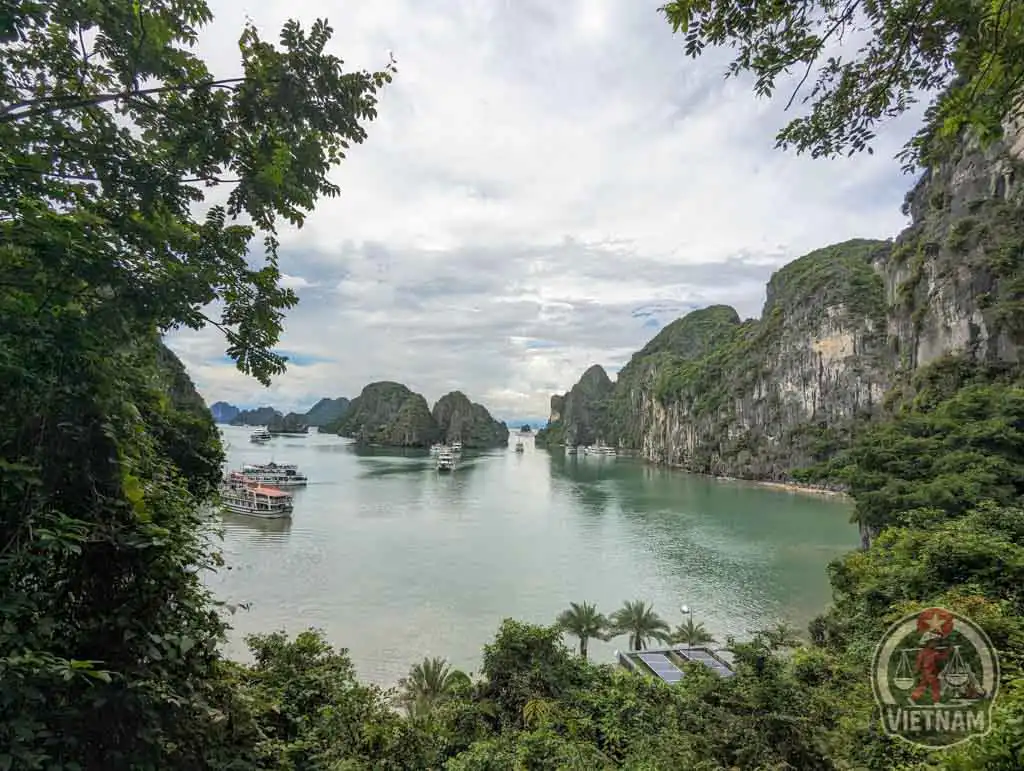
Halong Bay sits in the Gulf of Tonkin, in the province of Quang Ninh, in northeastern Vietnam. This breathtaking natural landscape holds around 1,600 islands and islets, most of them still uninhabited to this day.
The name “Ha Long” translates roughly as “descending dragon”. In Vietnamese culture it’s tied to a legend linking this place and its peculiar shapes to dragons that descended from the sky to help the Vietnamese people fight off foreign invaders and protect their land — spitting fire and jade which, over time, turned into the imposing limestone formations that now define the bay.
Legends aside, from a scientific standpoint Halong Bay is a spectacular example of a highly evolved karst landscape. These limestone formations have been sculpted over millennia by erosion and other natural processes, creating an environment that is unique and visually stunning to our eyes today.
Halong Bay is unquestionably one of the essential places to see in Vietnam. It was declared a UNESCO World Heritage Site in 1994 and is considered by many to be one of the 7 wonders of the natural world.
When is the best time to visit Halong Bay?
Choosing well when to travel to Halong Bay can make the difference between a beautiful experience and a boat ride through the clouds. Here’s what to expect from each season in Halong Bay.
February to May, the ideal window for Halong Bay
The best time to visit Halong Bay is usually between February and May. These months bring more stable weather, clear skies and pleasant temperatures: ideal conditions for sailing and enjoying the landscape without mist or rain.
That said, any time of year can be good for visiting Halong Bay. The weather in northern Vietnam is unpredictable, and dry season is no guarantee of sunshine. You can get gray days in April or clear skies in July. Best to go with an open mind.
Halong Bay in winter (December to February)
Visiting Halong in winter has its pros and cons.
The biggest drawback is the cold. While temperatures aren’t extreme, the combination of wind, humidity and being out on the water can make it feel sharper. Lows hover around 8-10 °C (46-50 °F). It’s no Siberia, but it’s worth packing warm clothes, especially for nights on board.
The upside? Fewer tourists, and visibility often improves thanks to the cleaner air.
Halong Bay in summer (June to September)
Summer coincides with monsoon season. It rains frequently, temperatures run high and humidity is intense. It may not sound like the best time for a cruise around the bay.
Even so, it’s domestic high season, and the crowds keep coming. If you’re traveling on these dates, the ideal approach is to pick the most stable day according to the weather forecast.
Rain shouldn’t ruin your experience, but it can limit the views or certain outdoor activities.

Yes. Halong Bay is one of Vietnam’s most iconic areas, a UNESCO World Heritage Site and considered one of the natural wonders of the world for its landscape.
Although it’s a heavily visited destination and can feel crowded in high season, it remains a breathtaking experience for most travelers.
The one-day tour is ideal if you’re short on time, letting you see the essentials of Halong Bay and enjoy the sunset from the boat.
If you have more time, go for a 2-day, 1-night cruise, the most balanced option for the full experience: sleeping in the bay and watching the sunrise the next day.
If you’re traveling unhurried, 3 days or more will let you combine Halong Bay with other areas such as Lan Ha Bay, Cat Ba island or Ninh Binh.
Prices vary by duration and boat category. A one-day tour from Hanoi generally runs between 1,000,000 and 2,000,000 VND (~US$38-77).
For a 2-day, 1-night cruise, prices on 4- or 5-star boats usually start at 4,000,000-6,000,000 VND (~US$154-231) per person; for something more luxurious they can reach 8,000,000 VND (~US$308).
Information reviewed and last updated on February 2, 2026